Summary: Brazil's starting lineup hinges on midfield balance, defensive coordination, and how the front line
Brazil's starting lineup rarely feels settled。and that is partly why it draws so much scrutiny. In modern tournament football, the difference between a cohesive XI and a collection of talented individuals often shows up in the first 20 minutes: how the midfield screens passes into the front line, how full-backs choose their moments, and whether the No. 9 receives service or spends the half chasing shadows. A lineup is not a list of names;
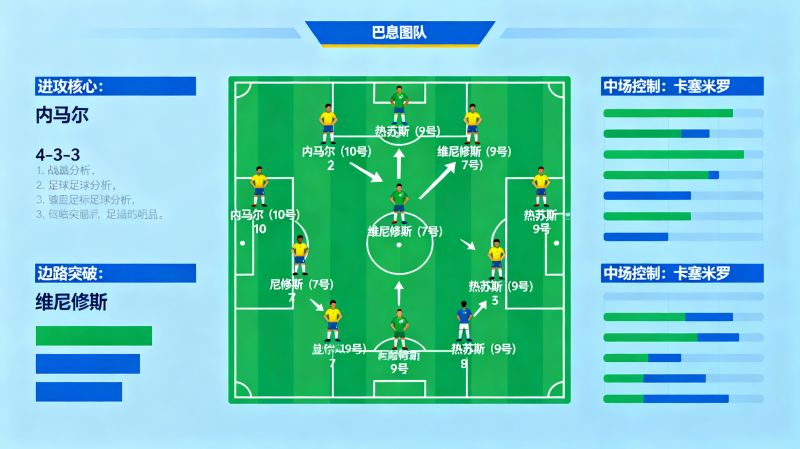
it is a set of compromises.Consider the midfield axis. A double pivot of a destroyer and a deep-lying passer gives the center-backs an easy outlet, but it can leave a gap between the lines when the opposition presses with two forwards and a No. 10. Brazil's best versions usually solve this with a third midfielder who drifts half-space, receives on the back foot。and turns. When that player is missing, the starting lineup looks top-heavy: wingers isolate, the striker drops deep, and the team ends up crossing from predictable angles. I have watched Brazil tilt right too often because the right-back overlaps earlier than the left, which compresses space for the inside forward. Small imbalances compound.The back line is where selection gets personal. A left-footed center-back changes the first pass angle to the left winger, and that matters against a mid-block that shifts toward the ball. Brazil's starting lineup often includes one aggressive center-back who steps into midfield and one who holds;pair two steppers and you get exposed to a simple ball over the top. Pair two holders and the build-up becomes slow. There is also the goalkeeper question: a sweeper-keeper supports a high line, but only if the starting lineup commits to pressing as a unit. Half-pressing is worse than no pressing.
Up front, the temptation is to start four attackers. Brazil's starting lineup has enough individual quality to make that work for 30 minutes, not 90. The more reliable structure uses a center-forward who occupies both center-backs, two wingers who stay wide until the ball is switched, and a No. 10 who arrives late in the box. Watch the body orientation of the striker when the team loses the ball: if he jogs back toward the center circle, the midfield gets outnumbered on the counter. If he angles his run to cut the pass into the pivot。the team wins five seconds to reset. These details decide knockout matches.Set pieces and substitutions are part of the starting lineup's logic, too. A lineup with three aerial threats invites more direct free-kicks;a lineup with none forces short routines. Brazil's bench often includes a game-changer who alters the defensive shape of the opponent, and the starting XI should be chosen with that 60th-minute switch in mind. My view: the most balanced Brazil starting lineup includes one holding midfielder who can pass under pressure。
one box-to-box runner, a left-back who tucks in rather than overlapping every time, and a striker who defends the first pass. Talent is not the constraint. Coordination is. When the starting lineup reflects that, Brazil controls matches without needing a moment of magic. When it does not, even a star-studded XI can look like strangers for long stretches.